Category: Guide

Dekorasyon ve kamp rehberleri

  • Personalized Metal House Name Signs: Text, Size and Mounting Guide

    Personalized Metal House Name Signs: Text, Size and Mounting Guide

    A small metal plate by your front door is the first detail every visitor notices. A well-chosen house name sign helps guests and delivery drivers find the right address, and it sets the tone for your entrance. But even a beautiful design stops doing its job if the lettering is too small or the size is wrong for the wall. This guide covers what to write, how to match letter size to viewing distance, how to choose a size, indoor versus outdoor use, mounting surfaces, and how personalization works at WiseDec.

    What to put on the sign

    The rule is simple: less text, better legibility. A metal plate has limited room, and every extra word shrinks the letters. For most homes, the best content is:

    • Family name: something short like “The Miller Family” or just “Miller” is plenty.
    • House or apartment number: it helps guests and couriers find you, especially in apartment buildings and gated communities.
    • A house name: a short name such as “Maple Cottage” adds personality to a home with a garden.
    • A short welcome: a word or two like “Welcome” works well. Longer sentences read better as wall lettering.

    If you want a longer phrase, browse the wall lettering category instead, where the letters have more room to spread out.

    Personalized Metal Door Name Sign
    Personalized Metal Door Name Sign →

    Letter size versus viewing distance

    Readability depends on the ratio between letter height and how far away the reader stands. A commonly used signage rule of thumb is about 1 inch (2.5 cm) of letter height for every 10 feet (3 m) of viewing distance. It is a guideline, not a standard, and lighting, contrast and typeface all change the result. Using that rule, you can think roughly like this:

    • Read from right at the door, 3 to 6 feet away: letters of about 1 inch (2.5 cm) are fine.
    • Read from a hallway or landing, 10 to 13 feet away: about 1 to 1.5 inches (2.5 to 4 cm).
    • Read from a garden gate or the walkway, about 20 feet away: about 2 inches (5 cm) or more.
    • A house number that must be seen from the street needs larger digits. Many areas set minimum number sizes through local codes or homeowners associations, so check your local rules.

    Contrast matters as much as size. A dark sign reads best on a light wall, and a light or bright sign stands out on a dark door. A model with a mirror layer behind the lettering, like the WiseDec Signify door name sign with its silver acrylic mirror back, adds a more eye-catching look to an entrance.

    Typeface counts too. Simple, bold letters are easier to read from a distance, while ornate or very thin script gets hard to read at small sizes. A quick test is to print your text large, tape it to the door and step back.

    Choosing the right size

    Start by measuring the surface where the sign will go. A door frame, a door panel and an open stretch of wall all offer different widths. A sign that fills roughly a third to a half of the available space usually looks balanced: too small and it disappears, too large and it crowds the door.

    Our name signs come in several size options. Compare the options on each product page with the reading distances above. A paper template taped to the door is an easy way to test a size.

    Indoor or outdoor use

    Indoors, such as an apartment door or a hallway, you are protected from rain, sun and damp, so design comes first. Outdoors, durability matters more. Our door signs are made from durable metal such as stainless steel or aluminum, and our Signify suits both indoor and outdoor spaces.

    For an outdoor spot, mounting the sign somewhere a little sheltered, rather than where it takes direct rain and sun all day, helps it last longer. Near the coast, check the material details on the product page.

    Personalized Locomotive Metal Door Name Sign
    Personalized Locomotive Metal Door Name Sign →

    Mounting surfaces and methods

    Where you mount the sign decides how you do it. Some general guidance by surface:

    • Wood door or trim: use short screws, and make sure they do not poke through the other side of the door.
    • Drywall or painted plaster: use wall anchors and screws, and check for wires and pipes before drilling.
    • Brick, stone or concrete: drill with a masonry bit and use anchors rated for that material.
    • Stucco or siding: choose fasteners made for the wall type, and seal outdoor holes against moisture.
    • Glass, tile or ceramic: drilling is risky, so ask us whether the sign suits a no-drill method before you buy.
    • Hollow metal door: check the door construction before drilling.

    Our Personalized Metal Door Name Sign comes with the parts needed for mounting in the box, along with an instruction guide. Still, check whether your wall type needs extra anchors before you start. A small level keeps the sign straight when you mark the holes.

    How personalization works at WiseDec

    The process is simple. Pick the sign you like, type your text into the personalization field on the product page, and place your order. Before production starts, we confirm the text with you, which helps catch a typo or a wrong number early. Double-check spelling and capitalization as you type.

    To choose a design, browse the personalized name signs category. The Personalized Metal Door Name Sign, the Locomotive design and the Floral design suit entrances with different personalities. There are also related products for other spots, such as the dog house name sign, which measures 30 x 10 cm (about 12 x 4 in).

    Leave your own mark at the door

    A good sign starts with short, clear text, a letter size that matches the viewing distance, and a secure mount. When you are ready to personalize one for your home, balcony or garden entrance, browse the product pages. If you are unsure about the wording or size, message us and we will help you decide.

    Frequently asked questions

    What should I write on a house name sign?

    Usually a family name and a house or apartment number are enough. Keeping the text short makes the letters larger and easier to read.

    How tall should the letters be?

    A common rule of thumb is about 1 inch (2.5 cm) of letter height per 10 feet (3 m) of viewing distance. A sign read at the door can use smaller letters, while numbers visible from the street need larger ones.

    How do I enter my text?

    You type it into the personalization field on the product page. We confirm the text with you before production.

    Can a metal name sign go outdoors?

    Our name signs are made from durable metal, and the Signify suits indoor and outdoor use. Check each product page for details, and choose a sheltered spot outdoors when you can.
  • How to Choose a Camping Grill: A Guide to Foldable, Portable Barbecues

    How to Choose a Camping Grill: A Guide to Foldable, Portable Barbecues

    The cooler is packed and the campsite is booked, but your backyard kettle will not fit in the trunk, and a flimsy cheap grill can warp the first time it meets real heat. A good camping grill is easy to carry, quick to set up, sturdy over a hot charcoal bed, and simple to clean. This guide covers what to look at when you choose one: portability, materials, cooking area, setup and cleanup, charcoal use and outdoor fire safety. We also compare our WiseGrill models and explain when a fire pit fits better.

    Portability: folding design and a carry bag

    How it folds and packs

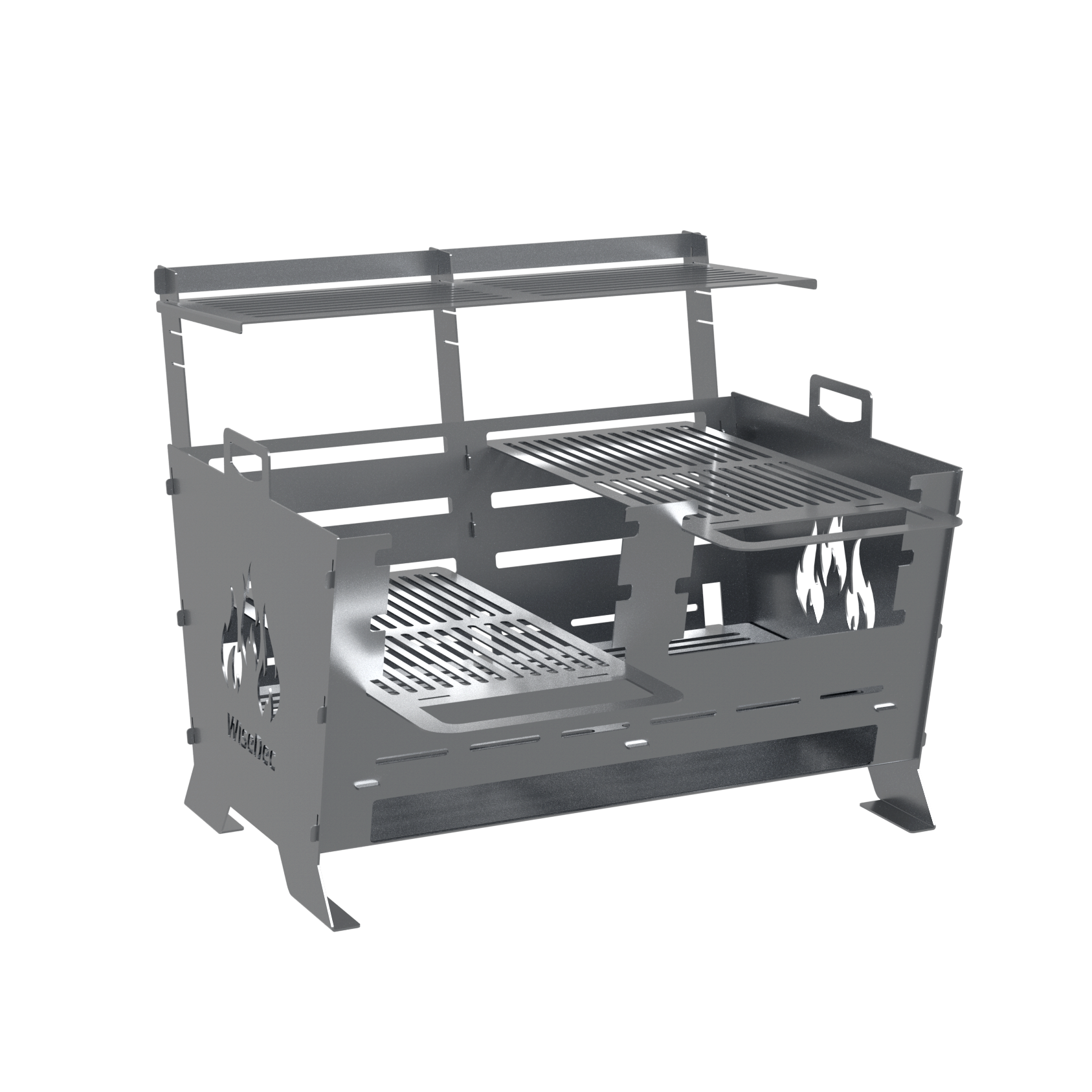
    Foldable or flat-packing grills collapse into a slim bundle that slides in beside a tent or cooler. What matters is how many steps the setup takes and how the parts connect. Our WiseGrill WG1, WG2, WG3 and WG4 are foldable, come with a carry bag and go together in a five-step snap-together assembly.

    Weight and the carry bag

    Our portable WiseGrill models are light and easy to carry. A carry bag is still worth having: it keeps sharp metal edges and soot away from the rest of your gear and makes a one-handed carry easier on a walk-in site.

    WiseGrill WG5 Portable Barbecue
    WiseGrill WG5 Portable Barbecue →

    Material and metal thickness

    Charcoal burns hot, and thin sheet metal can bend over time under that heat, so thickness matters as much as the type of metal. As a general rule, thicker steel holds its shape better, though it weighs a bit more. When comparing grills, look for:

    • Material type: stainless steel copes well with damp conditions, while painted steel needs a finish that can take the heat.
    • A stated thickness: our WiseGrill V7 is made of 1.5 mm metal (about 1/16 inch) in black.
    • Joints and fit: snap-together connections should lock firmly. A wobbly grill is an unsafe grill.
    • Grate and tray: removable parts make cleanup easier.

    Our WG5 and WG6 use stainless steel or quality metal, and our WG1 through WG4 use high-quality metal. For more detail on a specific model’s material, check its product page or message us.

    Cooking area versus group size

    A grill’s outer size is not its real cooking surface, but it is a useful hint. As a rule of thumb, a small grill suits two or three people with a few skewers or burgers, while four to six people are easier to feed on a larger grate.

    Our WG2 measures 40 x 40 cm (about 15.7 x 15.7 in) and stands 26 cm (about 10 in) tall, while our WG3 and WG4 measure 45 x 46 cm (about 17.7 x 18.1 in) and stand 35 cm (about 13.8 in) tall. The WG5 and WG6 add an adjustable-height grate for controlling heat.

    Setup and cleanup

    Choose a grill that goes together in a few steps without extra tools. For cleanup, let it cool completely, tip the ash out, scrub the grate with warm water and a brush, and dry every part before bagging it, since a wet grill invites rust.

    Using charcoal

    Our WiseGrill grills burn charcoal: the V8 is a charcoal grill, and the WG5 and WG6 include a charcoal tray among their accessories. The key is patience: light the coals, wait until they are covered in light gray ash, and cook over glowing embers rather than open flames, which scorch the outside while the inside stays raw.

    WiseGrill V8 Vertical Portable Barbecue
    WiseGrill V8 Vertical Portable Barbecue →

    Outdoor fire safety

    These are general safe-practice tips. Always check the rules where you are going, because open fires and charcoal grills are restricted at many parks and campgrounds, especially in dry seasons.

    • Confirm that fires and grills are allowed at your site, and do not light one where they are not.
    • Set the grill on level, stable ground, away from dry grass, brush, tents and anything that can burn.
    • Skip grilling in strong wind, which can carry sparks.
    • Never use gasoline or similar accelerants to start charcoal.
    • Keep water, sand or a bucket within reach, and never leave a fire unattended.
    • Never use a charcoal grill inside a tent, camper or any enclosed space; it can cause carbon monoxide poisoning.
    • Put the coals fully out when you finish, and do not leave or discard ash until it is cold to the touch.

    When a fire pit is the better choice

    If you care less about cooking and more about sitting by an evening fire for warmth and conversation, a fire pit may suit you better. Fire pits are built for open, larger flames. Our FlameHex Hexagon Fire Pit is made of stainless steel, weighs 12 kg (about 26 lb) and has a surface you can grill on, so you can still cook if you like.

    If portability comes first and you want only a small fire, our WiseGrill Camping Fire Box is compact: it is 17 cm tall and 13 cm wide (about 6.7 x 5.1 in), and you can put a pot on top and burn light wood inside. More options are in the fire pits category.

    How the WiseGrill models differ

    A short summary of our models:

    • WG1 to WG4: foldable, with a carry bag, grate and five-step assembly. Our WiseGrill WG4 is one of the larger-surface options.
    • WG5 and WG6: adjustable-height grate, charcoal tray, carry bag and quick assembly. Our WiseGrill WG5 belongs to this group.
    • V7: 1.5 mm metal in black, carry bag included. Our WiseGrill V7 is the one to pick for its 1.5 mm build.
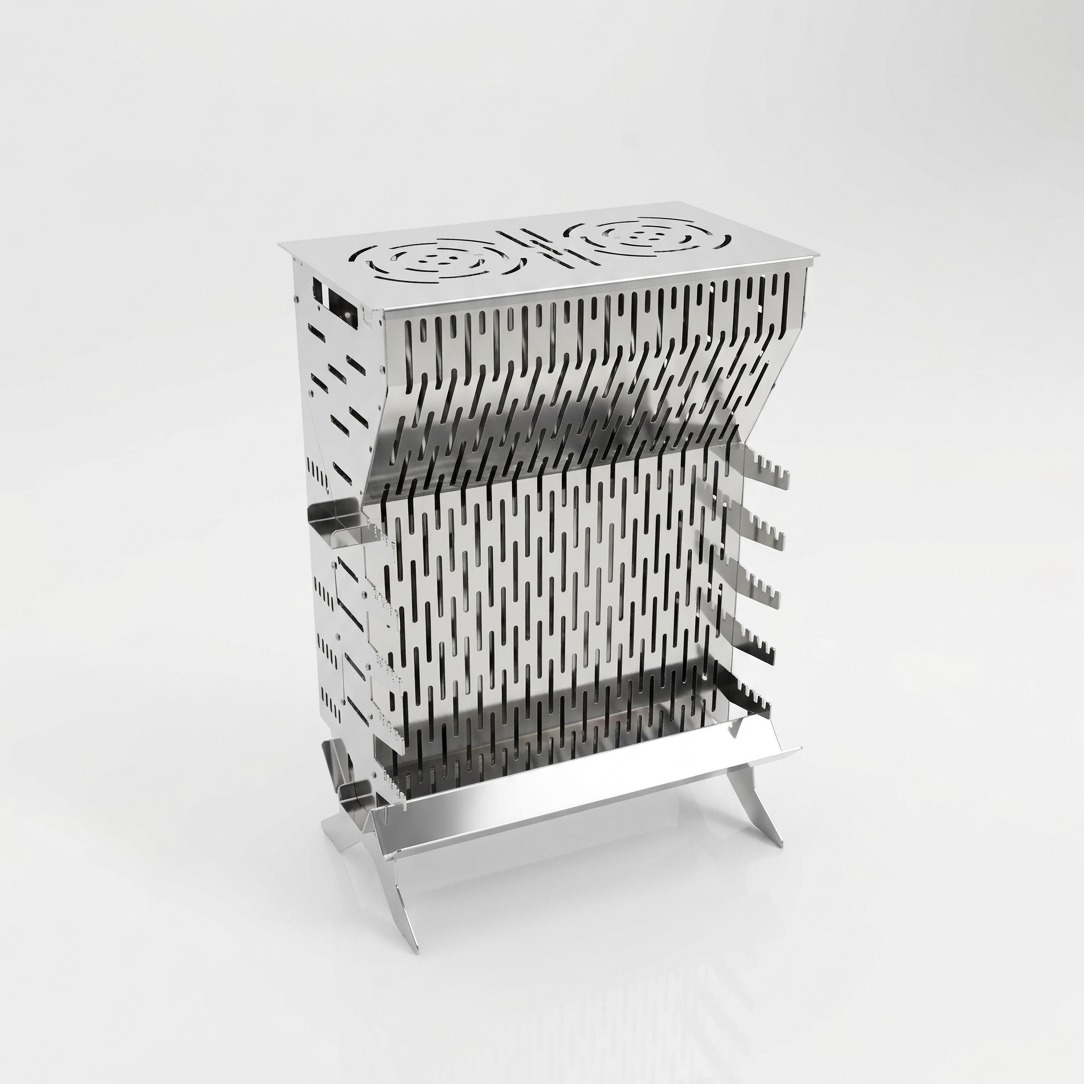
    • V8: a vertical design with skewers in side slots and a two-hole top plate for a kettle or bread. It measures 33 x 19 x 50 cm (about 13 x 7.5 x 19.7 in). Our WiseGrill V8 suits tight spaces.

    Pick the grill that fits your trips

    Walking in? Choose a foldable model with a bag. Feeding a crowd? Go for a larger grate. Short on space? Consider a vertical design. Browse the grills category, compare the dimensions with your trunk and your group, and message us if you are unsure which model fits.

    Frequently asked questions

    How big should a camping grill be?

    It depends on your group and what you cook. A compact grill works for two or three people, while a larger grate makes cooking easier for four to six.

    Are foldable grills durable?

    Durability depends mostly on the material, the metal thickness and the quality of the joints. Folding by itself is not a weakness. For example, our WiseGrill V7 is made of 1.5 mm metal.

    What fuel does a portable camping grill use?

    Our WiseGrill grills burn charcoal. Do not use gasoline or other accelerants, and check the fire rules where you plan to camp.

    Should I buy a grill or a fire pit?

    Choose a grill if cooking and portability come first, and a fire pit if you mainly want an evening fire for warmth. Some of our fire pits include a grill surface too, so check each product page.

  • How to Choose a Metal Wall Clock: A Practical Guide

    How to Choose a Metal Wall Clock: A Practical Guide

    A wall clock is the most functional piece of decor in a room: it tells time and, at the same time, sets the character of the wall. A clock in the wrong size either disappears on the wall or overpowers the room. This guide walks through what to look at when choosing a metal wall clock: size, style, mirrored versus matte black, hanging height, care and installation. The goal is to help you decide what you need before you open a product page.

    1. Measure the wall and the room first

    The most common mistake is choosing from a photo. On a screen, every clock looks like the right size. Measure your wall first, then cut a paper or cardboard circle at the clock’s diameter and tape it up to test.

    Size references

    The ranges below are starting points rather than strict rules. Always check the real dimensions on the product page.

    • Kitchen, bedroom, kids’ room: A diameter of about 12 to 16 inches (30 to 40 cm) is enough.
    • Hallway and entry: 12 to 18 inches (30 to 45 cm) reads comfortably at eye level in tight spaces.
    • Living room: 20 to 28 inches (50 to 70 cm) stands out without overwhelming the wall.
    • Large living room wall or high ceiling: A clock of 28 inches (70 cm) or more can be a focal point on its own.

    Above a sofa or console, the clock’s diameter should be roughly one third to one half of the furniture’s width. Over an 84-inch (215 cm) sofa, a clock of about 26 to 30 inches (65 to 75 cm) looks balanced.

    2. Think about reading distance

    A clock should be readable, not just attractive. If you will check the time from 10 to 13 feet (3 to 4 meters) away, choose large numerals, bold hands and strong contrast. Designs without numerals are more decorative but need a closer look, so in the kitchen or home office put readability first.

    3. Match the style to the room

    Metal wall clocks come in many design languages. Our wall clock collection ranges from classic Roman numeral models to city and map themed designs.

    • Classic and warm rooms: Roman numeral or Ottoman-inspired designs go well with wood furniture. The Roman Numeral Metal Wall Clock is an example of this direction.
    • Modern and minimal rooms: Geometric, circle or square forms suit clean lines.
    • Themed corners: City, map or music themed clocks add character to a home office or hobby corner. A design like the New York Metal Wall Clock stands out in these spaces.
    Roman Numeral Metal Wall Clock
    Roman Numeral Metal Wall Clock →

    4. Mirrored “Merror” or matte black?

    This is one of the decisions that most changes how the clock looks in the room.

    • Merror (mirrored) finish: A mirrored surface reflects light and adds movement and sparkle. In small or dim rooms it can create a feeling of brightness. On the other hand, on a wall that gets direct light, glare can make the hands and numerals a little harder to read, and fingerprints and dust show more.
    • Matte black finish: It does not reflect daylight, keeps the clock easy to read and looks calmer. On light walls it creates strong contrast.

    In short, if your room is dim and you want a decorative shimmer, Merror may be the better choice. If you want something practical, clear and calm, matte black is often the safer one. The Compass Metal Wall Clock Merror and the Prism Metal Wall Clock Merror are good examples of the mirrored look.

    Compass Metal Wall Clock Merror
    Compass Metal Wall Clock Merror →

    5. Wall color and what surrounds the clock

    A matte black clock is crisp on a light wall but can fade into a dark one. On dark walls a mirrored finish separates better. If the wall also holds art or shelves, keep the clock’s style in step with them. A map-themed clock next to a world map print can feel repetitive, so pair it with a simpler piece of art.

    New York Metal Wall Clock
    New York Metal Wall Clock →

    6. Hanging height and position

    Hang the clock so its center sits about 57 to 61 inches (145 to 155 cm) from the floor, which is roughly eye level when standing. Above furniture, leave 6 to 10 inches (15 to 25 cm) between the clock and the piece below it. In a living room, a clock suits a wall that is easy to see from the seating area. In a bedroom, hanging it opposite the bed or on a side wall is more comfortable to read than directly above the headboard.

    7. Movement and operation

    The movement affects day-to-day comfort. Check technical details such as the mechanism and whether it runs quietly in the product description, and if the information is not there, ask us before you buy. This detail matters most in bedrooms, where quiet counts. Most wall clocks run on a battery, so hang the clock at a height where you can take it down comfortably for battery changes.

    8. How to hang it

    • Identify your wall type, because brick, concrete and drywall each need different anchors.
    • Mark the center point and check it with a level.
    • Check the product page for how the clock hangs, and ask us if you are unsure.
    • Metal can be heavier than wood or plastic, so use a proper anchor rather than a single thin nail.
    • After hanging, check that the clock sits straight.

    9. Cleaning and care

    Oven-cured painted metal is easy to care for. A dry or slightly damp soft cloth is usually enough. Abrasive sponges, harsh chemicals and scratchy products can damage the finish, so avoid them. On Merror surfaces, wiping fingerprints with a microfiber cloth gives the cleanest result. Keep liquid away from the movement.

    Quick checklist before you buy

    You have measured the wall, picked a size and decided on a finish. Now browse our metal wall clock collection, where each model’s dimensions and details are on the product page. The clocks are made in the WiseDec workshop with laser cutting and an oven-cured finish. If you are undecided, send us a photo of your wall.

    Frequently asked questions

    What size should a metal wall clock be?

    About 12 to 16 inches (30 to 40 cm) suits a kitchen or bedroom, and 20 to 28 inches (50 to 70 cm) suits a living room. Large walls can take 28 inches or more. Taping a paper circle to the wall is the safest way to test.

    How high should I hang a wall clock?

    Hang it with the center about 57 to 61 inches (145 to 155 cm) from the floor. If it sits above furniture, leave 6 to 10 inches (15 to 25 cm) between the clock and the furniture.

    Is a mirrored or a matte black clock better?

    A mirrored finish reflects light and adds sparkle, while matte black is easier to read and calmer. On a wall with direct light, matte black is more practical, and in a dim room a mirrored finish has more impact.

    How do I clean a metal wall clock?

    A dry or slightly damp soft cloth is enough. Avoid abrasive products, and use a microfiber cloth for fingerprints on mirrored surfaces.

  • Living Room Wall Decor Ideas: 9 Ways to Style Metal Wall Art

    Living Room Wall Decor Ideas: 9 Ways to Style Metal Wall Art

    The living room is where most people spend their evenings and where guests form their first impression, yet the biggest wall is often left bare or filled with a few frames hung at random. Good living room wall decor does not take a renovation. The right size, the right height and a couple of pieces with real character usually do the job. Below are nine ideas for styling laser-cut, powder-coated metal wall art, along with the measurements that make them work.

    Before you start: three measuring rules

    Keep these three rules in mind. They explain most of the cases where a wall looks too empty or too crowded.

    • Width: Art hung above furniture should span roughly two thirds of the furniture’s width. For an 84-inch (about 215 cm) sofa, a total composition of 55 to 58 inches (about 140 to 148 cm) looks balanced.
    • Height: Hang the center of the piece about 57 to 61 inches (145 to 155 cm) from the floor, which is roughly average eye level.
    • Gap: Leave 6 to 10 inches (15 to 25 cm) between the sofa back and the bottom edge of the art. Hang it higher and it floats away from the furniture.

    1. One large statement piece over the sofa

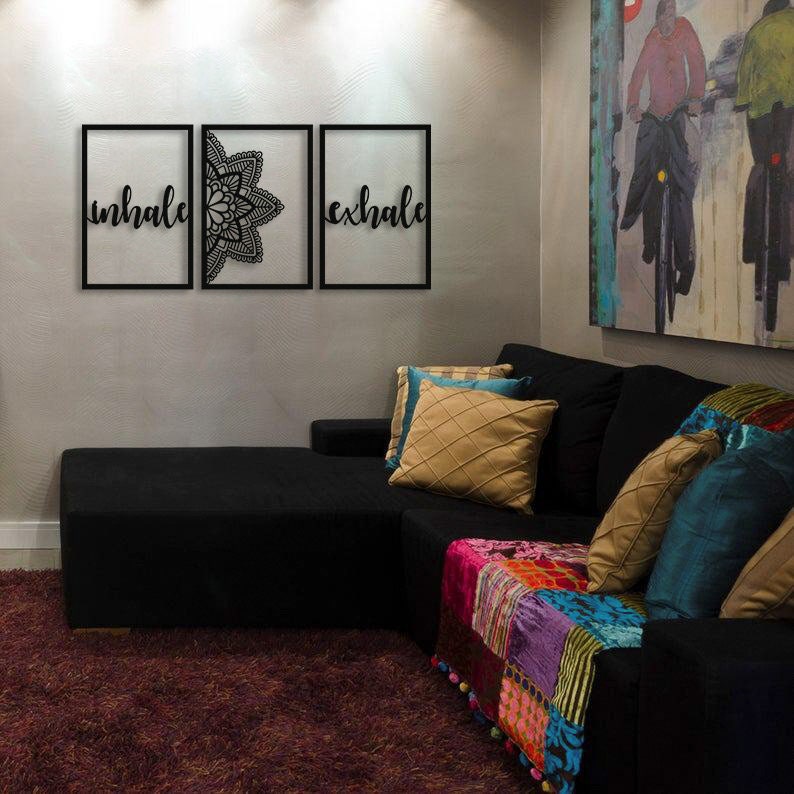
    The simplest and most effective approach is a single wide piece above the sofa. One piece gives the room a clear focal point and keeps the wall calm. Wide, open compositions such as mandalas, trees or landscapes from our metal wall art collection suit this role well.

    Mandala Metal Wall Art
    Mandala Metal Wall Art →

    2. A world map for a long wall

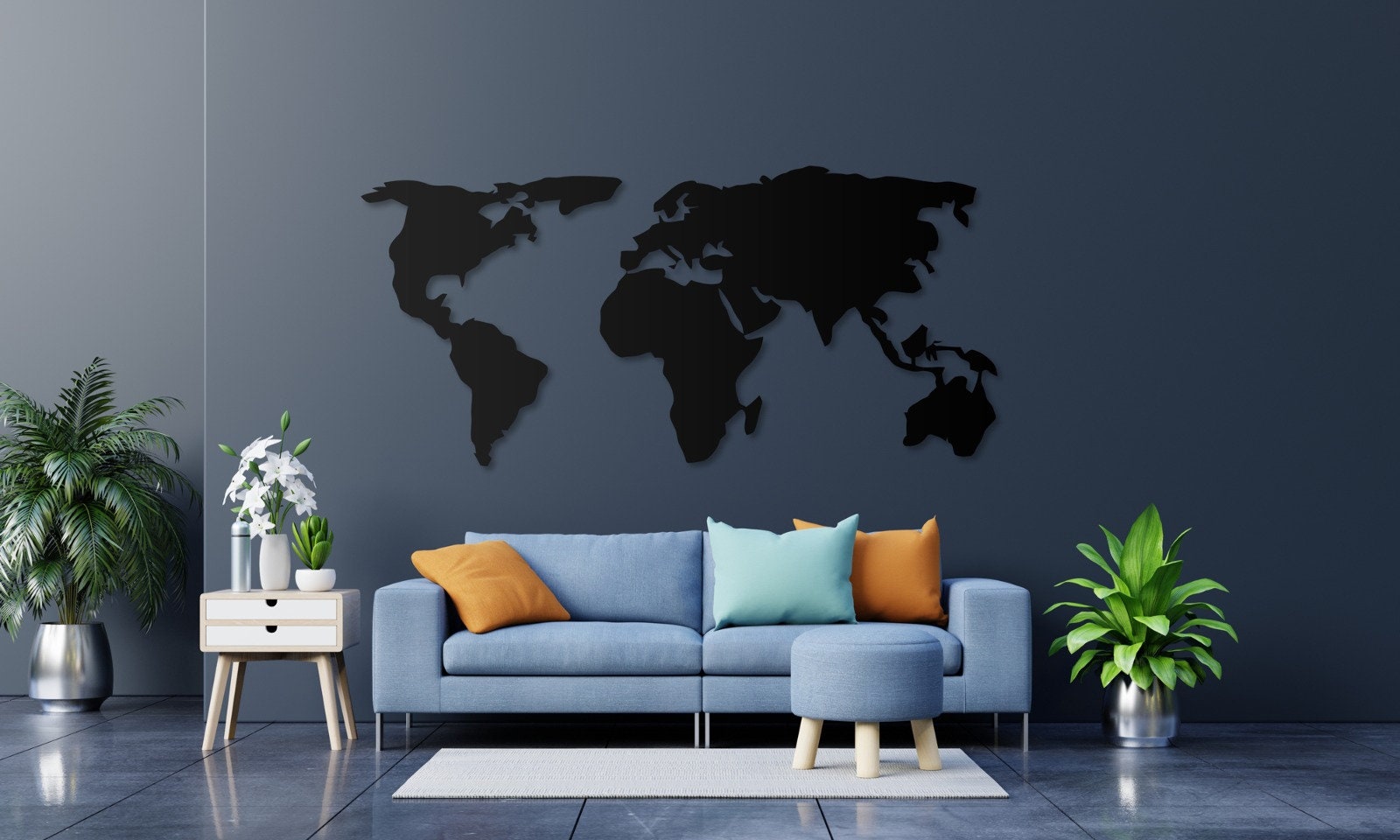
    If you have a large blank wall, a world map is both decorative and a conversation starter. Its horizontal shape fits the long wall behind the sofa, opposite the TV or beside a work corner. Our world map category includes classic, compass-style and half-map interpretations. On a plain wall, the Classic World Map Metal Wall Art is an easy place to start.

    Classic World Map Metal Wall Art
    Classic World Map Metal Wall Art →

    3. A pair or trio gallery layout

    Instead of one big piece, hang two or three pieces of equal size side by side. Leave 2 to 3 inches (5 to 8 cm) between them, treat the group as a single artwork and center it at the same 57 to 61 inch height. In a trio, choosing a slightly different design for the middle piece adds rhythm.

    4. Mirrored “Merror” surfaces for light

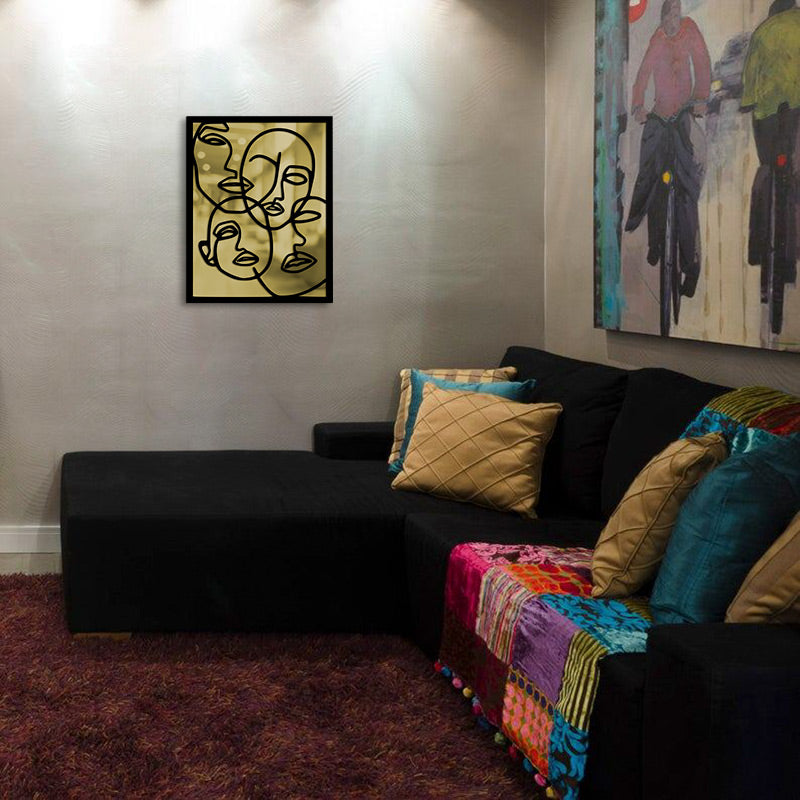
    Mirrored-finish metal pieces, which we call Merror, bounce room light around in a moving way. Hung opposite a window or on a side wall, they look different throughout the day. In a small or dim living room the reflections can make the space feel a little brighter. A piece such as the Merror Face Lines Metal Wall Art is a good example of the effect.

    Merror Face Lines Metal Wall Art
    Merror Face Lines Metal Wall Art →

    5. Typography and motivational pieces

    Lettering is a quick way to show personality. A short phrase or a single word works well on the narrow wall beside a media console or at the corner leading to a hallway. Our wall sign collection offers a range of messages. Let a lettered piece stand on its own, because too many patterns beside it will drown out the message.

    6. Black metal against a neutral palette

    In a living room built on beige, gray or cream, a black powder-coated metal piece creates a graphic contrast. The open, laser-cut areas let the wall color show through as part of the design, so the wall color matters: thin-line designs can disappear on a dark wall and look crisp on a light one.

    7. Add lighting for the evening

    Because living rooms are used mostly after dark, it makes sense to support wall decor with light. Our illuminated wall art and sconces give the wall a warm focal point once the main lights are off. Plan the cable route ahead of time, since choosing a wall near an outlet makes installation easier.

    8. Pair art and a clock on one wall

    A wall clock is also a decor piece. If it shares a wall with art, keep the two in related tones and styles. One can be mirrored and the other matte black, but both should lean the same way, either geometric or organic. Browse our metal wall clocks to find a size that suits your wall.

    9. Vertical compositions for corners and door sides

    Not every living room has a wide wall. For narrow gaps beside a door or between a window and a corner, go vertical. Two small pieces stacked on top of each other fill the space and balance the horizontal weight of the room. In tight spots, two pieces in graduated sizes look more comfortable than one oversized piece.

    Practical hanging tips

    Metal pieces can feel heavier than wood or paper prints, so use anchors and screws that match your wall type, whether brick, concrete or drywall. Before drilling, cut a paper template and tape it to the wall to check size and height. For cleaning, a dry or slightly damp cloth is enough. Avoid abrasive products.

    Which idea fits your living room?

    You do not need to try all nine on one wall. Measure your wall, pick one idea and test it with a paper template. When you are ready, browse our metal wall art collection to find a piece, made in the WiseDec workshop with laser cutting and an oven-cured finish, that suits your room.

    Frequently asked questions

    How high should I hang art in the living room?

    Hang the center of the piece about 57 to 61 inches (145 to 155 cm) from the floor. Above a sofa, leave 6 to 10 inches (15 to 25 cm) between the sofa back and the bottom edge of the art.

    What size art should go above a sofa?

    The total width of the art or the group of pieces should be about two thirds of the sofa’s width. On an 84-inch sofa, around 55 inches in total width looks balanced.

    Does metal wall art go with wood furniture?

    Yes. Black metal contrasts nicely with the warmth of wood. The key is to limit the number of colors and patterns: if your furniture is busy, choose a simpler piece of art.

    Is one large piece or several small ones better?

    In small, simple rooms, one large piece feels airier. On wide walls, or if you want a more personal look, a two or three piece gallery layout has more impact.

WhatsApp Support0549 322 30 01